
‘Completely rewarding’: Methodist Women's Hospital NICU staffers reflect on 3 decades of care as neonatal nurse practitioners
Published: Sept. 18, 2026
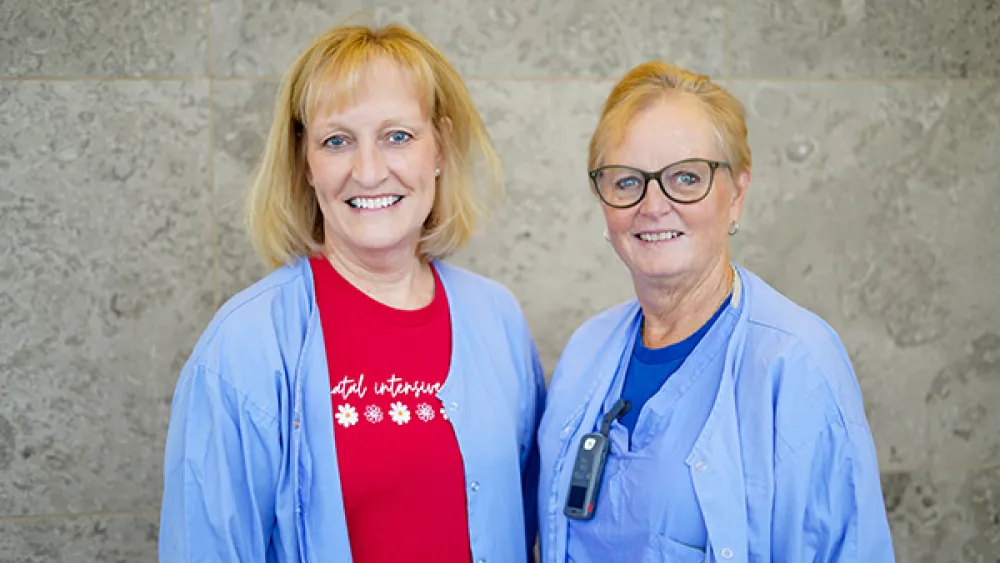
It’s fair to call Kim Murcek, MSN, APRN, NNP-BC, and Kay Mettling, APRN-NP, pioneers in their field.
The veteran neonatal nurse practitioners (NNPs) have worked in the Methodist Women’s Hospital Neonatal Intensive Care Unit (NICU) since it opened in June 2010. Along the way, they’ve witnessed two NICU expansion projects, significant advances in neonatal care and an admission rate that’s more than doubled – from 449 infants in 2011 to 933 in 2025.
Their dedication and expertise have helped the unit become a premier provider of care for infants with extreme prematurity, with acute illness and who are in need to intensive medical care.
But their story goes back much further, to the birth of the NNP role in Nebraska in the early 1990s. Murcek and Mettling, who at the time worked at what’s now Children’s Nebraska, were among the first nine nurses selected for specialized training to assist neonatologists with infant care.
“I was completely honored to be chosen,” Murcek said. “I was incredibly grateful for the opportunity and excited to continue growing in my career.”
“I credit neonatologist Dr. John Esslinger, now retired, who initiated neonatal nurse practitioners in Nebraska,” Mettling said. “The neonatologists were eager to have NNPs in the NICU.”
Five nurses were sent to West Virginia for training. Murcek, Metting and two others traveled to South Dakota. They returned as certified neonatal nurse practitioners and later received master’s degrees in nursing.
The role of an NNP
Among Murcek's and Mettling's many duties: attending high-risk deliveries or other deliveries with risk factors; performing physical assessments; ordering labs and tests, and interpreting their results; attending daily rounds with the multidisciplinary team and establishing plans of care; doing evening rounds with bedside nurses; providing newborn nursery consults requested by pediatricians; bedside teaching with nurses; adjusting fluids and medications as needed; and maintaining a steady stream of communication with parents, families and staff.
“We are physician extenders,” Murcek said. " As NNPs, we can diagnose conditions and prescribe treatments in collaboration with the neonatologists. We respond to the infant's changing condition 24/7."
In addition to their clinical expertise, NNPs need the qualities that so many successful nurses possess, Mettling said.
“We’re kind, empathic and team players,” she said. “We have strong critical thinking and assessment skills. We’re confident, patient advocates, leaders, creative, trustworthy, educators and, most of all, true friends who work well together and support one another.”
From Children’s to Methodist Women’s Hospital
The duo’s Methodist journeys began with the opening of Methodist Women’s Hospital in 2010. At the time, Methodist Hospital was a busy destination for expectant mothers. Nearby Children’s handled more specialized infant care, including in its NICU. Collaboration between the two hospitals was a fact of life.
However, with the opening of Women’s Hospital, which would include a NICU, birth services at Methodist Hospital ended. Murcek and Mettling again had the opportunity to be part of a story’s first chapter. They joined the team at the new hospital.
“I thought it would be intriguing to go and start up a NICU in a hospital that didn’t have its own,” Murcek said. “We went from scratch zero to building a unit. Now we can have up to 76 babies if needed. To be a part of that has been exciting and gratifying.”
Said Mettling: “The transition from Children's to Methodist Women's Hospital was seamless to me. I enjoy the delivery room experience and taking care of babies immediately after birth. It was challenging but also very rewarding being a part of the development of the NICU.”
Over three decades, Murcek and Mettling have seen advances in care that improved outcomes for premature infants. Among the most impactful have been changes in respiratory management, including improvements to ventilators. Both NNPs also noted the adoption of surfactant therapy – a medication that helps keep infants’ airways open so they can breathe more efficiently.
‘Surfactant was a lifesaving new medication back in the ‘90s,” Murcek said. “Administration of surfactant is now a common procedure today, the standard of care.”
‘It doesn’t get any better than that’
Today, 16 NNPs work in the Women’s Hospital NICU, providing care 24/7, 365 days a year. As important as their role is, they’re just one part of a larger team supporting infants and their families.
“Communication between team members is essential,” Murcek said. “Everyone needs to be on the same page for the day, for the week or for the months ahead depending on the infant’s condition. As a collaborative team, you're working with physicians, other nurse practitioners, the bedside nurses, respiratory therapists, pharmacists, dieticians, feeding specialist and social workers.”
She continued: “It's a matter of trust. You have to communicate with one another and know that you all have the same shared goal: Make sure the baby is healthy and stable enough to safely go home.”
Murcek and Mettling aren’t ready to make any retirement announcements just yet, but they each acknowledge that they’re in the home stretch of their careers. And while there have been difficult moments, heartbreak and loss, they know how important their work is.
“I especially love it when parents remember the care you provided even after many years,” Mettling said. “Some of the nurses I work with today I took care of when they were patients in our NICU.”
“It’s completely rewarding,” Murcek said. “When you admit a 24-weeker, you know they’re going to be in the NICU for months. It's a roller-coaster ride for the infant, for their parents and for us, too. But to see the 24-weeker at 1 pound at birth go home months later, it doesn't get more fulfilling than that.”